
Preloader Close
Quality Woodworks
Tell Us About Your Project

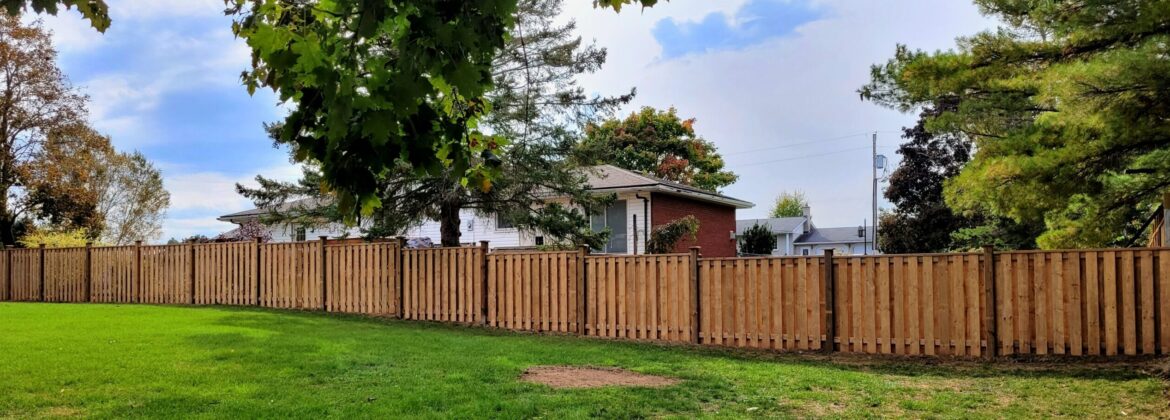
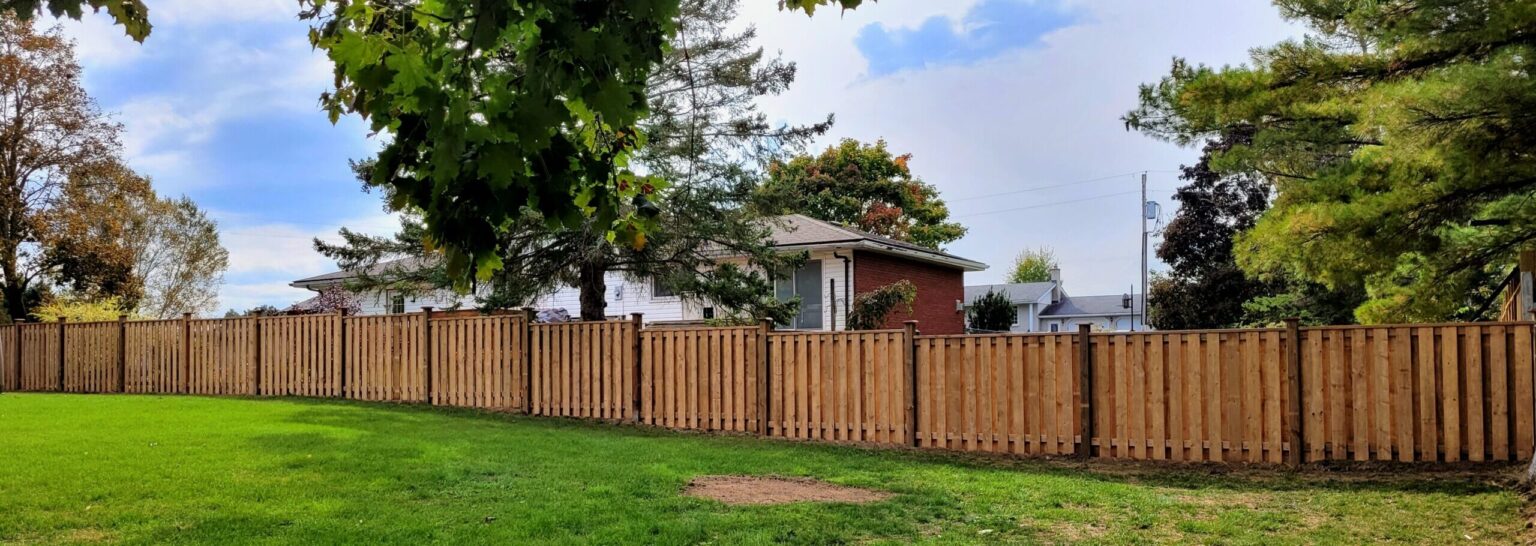
What Makes a Fence Last? Why Proper Fence Construction Matters
A fence isn’t just a fence. Two fences can look almost identical when they’re new. Same height, same lumber, same style. But give them a few Ontario winters and the differences start to show.
One stays straight, solid and functional. The other develops bowed boards, loose framing, leaning posts or a gate that no longer closes properly.
The difference is often found in the parts homeowners don’t notice on installation day.
Post depth. Footing size. Rail construction. Fasteners. Connections. Gate framing.
For most homeowners, replacing a fence is something they want to do once and do properly. That is why choosing the right fence contractor should involve more than comparing the number at the bottom of two estimates.
Sometimes the cheaper fence is genuinely the better value.
Sometimes cheaper today becomes more expensive later.
A Good Fence Starts Below Ground
Once a fence is finished, you can see the posts — but you cannot see the part doing most of the work.
That is why proper post installation matters. At Quality Woodworks, our typical post installation is 4 feet deep, with 42 inches considered our minimum, subject to actual site and soil conditions.
Our standard footing sizes are:
4×4 wood posts and PostMaster steel posts:
9-inch diameter hole with approximately two bags of concrete.
5×5 and 6×6 wood posts:
12-inch diameter hole with approximately three to four bags of concrete per post.
For our 4×4 wood-post installations, we also incorporate a gravel base and drainage collar to assist drainage around the lower portion of the post and reduce prolonged moisture exposure. The same detail can be incorporated with larger wood posts when desired.
Ontario fences deal with frost, saturated soil, wind, snow and repeated freeze-thaw cycles. There is no shortcut that makes the underground portion of a fence unimportant.
The fence above ground can only be as stable as what is supporting it below ground.
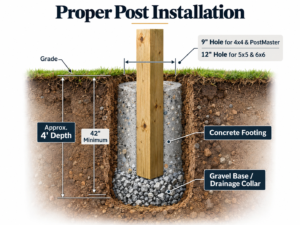
Proper post depth, an appropriately sized concrete footings and attention to drainage all contribute to long-term fence stability.
Full-Privacy Fencing Deserves Three Rails
One of the simplest ways to reduce the cost of a wood fence is to remove framing. That does not mean it is always a good place to save money.
For our full-privacy wood fences, three horizontal rails is always used unless requested otherwise.
Why you ask?
A six-foot fence board supported only near the top and bottom has a long unsupported section through the middle. Adding a centre rail provides another fastening point, helps control board movement and bowing, and strengthens the fence panel as a whole.
It becomes particularly important with privacy fencing because a solid fence catches substantially more wind than an open design.
Two-rail construction can make perfect sense for certain heights or semi-private and open fence styles, where wind can pass through and the boards do not require the same centre support.
But when we’re building a full-privacy fence, we prefer the additional structure of a third rail.
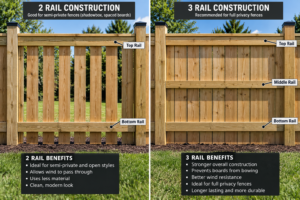
Two rails can be appropriate for more open fence styles. A third rail provides additional support through the centre of a full-privacy fence.
How the Rails Are Attached Matters Too
Having three rails does not help much if the connections holding them together are weak.
We use 4-inch exterior structural-grade screws for our primary wood framing connections rather than relying solely on standard framing nails or clips which don’t provide much hold.
The rails are securely fastened into the posts, with additional angled toe-nail fastening at the upper and lower portions of the connection to the post. We also securely fasten our top-cap connections through the sides into the post as well.
Why put so much attention into the connections?
Because the top of a fence has considerable leverage. Wind and seasonal movement continually work against the upper portion of the structure. Small amounts of movement repeated thousands of times are what eventually loosen weaker assemblies. Also, add in the potential for twisting or warping as the pressure-treated post dries.
Good fence construction is not just about putting enough lumber into the fence, It’s about making that lumber work together as one structure.
The Smallest Parts of the Fence Still Matter
A typical privacy fence contains hundreds — sometimes thousands — of fasteners. We use stainless-steel ring-shank nails for our fence boards.
Stainless steel provides excellent outdoor corrosion resistance and greatly reduces the chance of rust staining or dark streaks developing around the fasteners as the fence ages.
Quality exterior-rated galvanized fasteners can also be appropriate for treated lumber when properly specified. We choose stainless for our pickets because we want the added corrosion resistance and clean long-term appearance.
It is a relatively small part of the total cost of a fence.
It can make a noticeable difference several years later.
Gates Are Where Good Construction Gets Tested
A stationary fence panel has an easy life compared to a gate.
A gate hangs from one side, opens and closes with every use and continuously places leverage and stress on its hinged post. Make a gate too heavy, frame it poorly, use undersized posts, set them too shallow, skimp on concrete, or leave out proper top support and movement becomes much more likely over time. Once the posts begin to shift or twist, gravity takes over and the gate eventually sags, drags or stops functioning properly.
Our wood gates use a reinforced Z-frame construction, with structural lag fasteners at critical framing connections.
We also try to build the gate strong without making it unnecessarily heavy. Adding weight for the sake of making a gate feel substantial can actually work against you by increasing the load on the hinges, posts and fasteners.
Where the design permits, we also install a top support header connecting the gate posts. That header helps tie the two posts together, maintain alignment and resist movement or twisting around the gate opening.
It is a simple construction detail with a very practical purpose:
Help the gate stay where it was originally installed
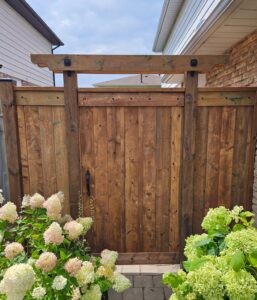
A reinforced gate frame, quality hardware and a properly secured top support help maintain alignment and reduce the conditions that contribute to gate sag.
Not Every Fence Quote Is Quoting the Same Fence
This is something homeowners should understand before choosing a contractor.
Imagine receiving two estimates that both say:
“6′ pressure-treated full-privacy fence.”
They sound identical.
But one contractor may be quoting for:
– deeper post installation
- – larger-diameter footings
– additional concrete
– larger posts
– three horizontal rails
– structural framing screws
– stainless-steel picket fasteners
reinforced gate framing
– heavier-duty gate hardware
– proper header support
The other quote may simply specify the finished appearance.
Those aren’t necessarily the same fence.
That does not mean the highest quote is automatically the best contractor either.
It means homeowners should understand exactly what is included in the construction before deciding which quote represents the better value. The final price tells you what the job costs; the scope of work tells you what you’re actually getting for that money
Questions Worth Asking Your Fence Contractor
Before choosing a fence builder, ask a few simple questions.
How deep will the posts be installed?
“Below frost” or “deep enough” is less useful than an actual construction standard.
How deep, what size holes and how much concrete will be used for the posts?
How many rails will a full-privacy fence have?
How are the rails attached to the posts?
What type of fasteners are being used?
How is the gate framed and supported?
Is cleanup included once the job is complete?
A finished fence should come with a finished jobsite. Cleanup, debris removal and leaving the property tidy should be part of the work — not an extra or an afterthought.
A good fence contractor should be comfortable answering those questions.
If two estimates are significantly different in price, the answers can also help explain why. Get multiple quotes and be sure to always compare the overall project scope.
The Cheapest Fence Isn’t Always the Least Expensive Fence
There is nothing wrong with looking for value.
You should.
But the lowest initial price and the lowest long-term cost are not necessarily the same thing.
Saving money by using less concrete, fewer rails, cheaper hardware or lighter construction can make a fence less expensive to install.
If those savings lead to repairs, reconstruction or premature replacement several years later, they were not much of a cost saving contractor.
And realistically, replacing a fence is one of the last projects most homeowners want to pay for twice.
A well-built fence costs money.
So does rebuilding a poorly built one.
Build It for Year Ten, Not Just Day One
Almost any new fence can be made to look good in a photograph.
The better measure of workmanship is what happens after years of wind, rain, snow, frost and everyday use.
That is why we pay attention to the details that disappear once the project is finished:
the depth of the posts, the concrete around them, the framing behind the boards, the fasteners holding everything together and the construction of the gate if included.
At Quality Woodworks, our approach to fence installation is straightforward:
Build it properly the first time.
We provide professional fence installation throughout the Durham Region & Clarington, including Oshawa, Whitby, Brooklin, Ajax, Pickering, Courtice and Bowmanville.
You can learn more about our Fence Installation Services, Post Hole Installation Services, Gate Installation Services or view our completed fence projects to see how these construction details come together on real builds.
Planning a New Fence?
If you’re considering a new privacy fence, custom wood fence, PostMaster system or gate project, we’d be happy to discuss options or take a look at your property and go over the right construction approach for your project.
Leave A Comment